
It’s an all-time high for sea turtle nest on Pawleys Island
Sea turtle nesting on Pawleys Island is at an all-time high with 50 nests created so far this turtle season, which runs from mid-May to mid-October.
With 50 nests logged as of Aug. 3, officials say the 2026 turtle nesting season on Pawleys Island is already a record-setting year. Hatching success rates are also very impressive with an average of 85 percent live hatchings in recent nests inventoried.

From mid-May to mid-October, known as turtle season, female sea turtles crawl up the beach to the dunes at night to lay their eggs, burying them in the sand. A “false crawl” signifies a failed attempt by the mother to lay eggs.
Volunteers with South Carolina United Turtle Enthusiasts, or SCUTE for short, walk the Pawleys Island beach every morning in search of turtle tracks. Nests are marked and monitored until the eggs hatch, then SCUTE conducts an inventory of how many eggs hatched and how many baby turtles are still in the nest.
Last year, SCUTE monitored 20 nests on Pawleys Island, which was considered a successful year. Since the turtles more than doubled that amount this season, organizers say this was the best year yet. That success stems, in part, because of courteous beachgoers and vacationers.
“High hatching success rates have been wonderful, and we hope they continue,” said Mary Schnieder, SCUTE coordinator for Pawleys Island. “The South Carolina Department of Natural Resources tells us that a 70-plus percent signals species preservation.”

A caring public
Each season, SCUTE leaders ask the public to be aware of this special time of year and do their part to help the sea turtles, and it seems to be paying off. Rick Scott, head of SCUTE, which spans beaches from Myrtle Beach to the north and Georgetown to the south, said it is always a challenge to communicate to the public the importance of turning off beach-facing lights, keeping overnight and filling in beach holes, which could deter mother turtles from .
We have an ongoing battle with lights on in the beach-facing homes and their garages,” Scott said. “When hatchlings come out of the nest they will follow the strongest source of light, thinking it is the moon. Then they become disoriented and we find ourselves picking up turtles in the street, garages, etc.”
Scott has served as head of SCUTE for the last four years and has been a member of the organization since 2011. He was a beach coordinator from 2019 to 2022. He said protecting loggerhead sea turtles is very important.
“Momma turtles look for dark, quiet locations to lay their eggs,” Scott said. “We encourage the public to turn off all beachfront lights and fill in large holes on the beach from May-October to foster a safe environment for nesting.”
Walking the beach
Schneider said all of the volunteers are eager to help during turtle season when they walk the Pawleys Island beach early in the morning.
“A huge thank you to our 60-plus dedicated volunteer walkers who patrol four miles of beach at dawn to spot and report nesting and hatching events for follow up protection,” she said.
Scott said he is proud of the volunteers who walk the beach looking for crawls, which are tracks on the beach by the mother turtles.
“When there is a nest, we call on the certified team to handle the eggs,” Scott said. “Then when the nests hatch the same core team of beach leaders handle the digging up of the eggs, the public education and the crowd management that many of our public sessions draw.”
Every second or third year, female turtles lay four or five nests a season, each containing an average of 120 table-tennis-ball-sized eggs. Nests that are laid in the inter-tidal zone or areas at risk for foot traffic are carefully relocated by SCUTE volunteers who have been trained and authorized by the South Carolina Department of Natural Resources. You can spot SCUTE-tagged sea turtle nests by their distinctive orange screening and orange signs on nest poles.

(Photo by ©maryschneider@sc.rr.com)
Schneider, who has served as a SCUTE coordinator for Pawleys Island for more than 20 years, said that the number of nests on the island this season is amazing.
“We have 50 nests which is a new annual record for Pawleys Island,” she said.
Scott said he is very pleased with the record number of nests this season.
Other SCUTE locations on the South Carolina’s Hammock Coast include Debordieu, near Georgetown, which has 39 nests so far; Hobcaw/Prince George, which has 23; South Litchfield, which has 13; Lichfield By The Sea, which has four; North Litchfield, which has five; and Huntington Beach State Park, which has 22 nests. North Island, which is uninhabited, has 201 nests this season.
“Since loggerhead turtles nest every two to three years, the turtles we are seeing this year last laid nests here in 2023 or 2024,” Scott said.
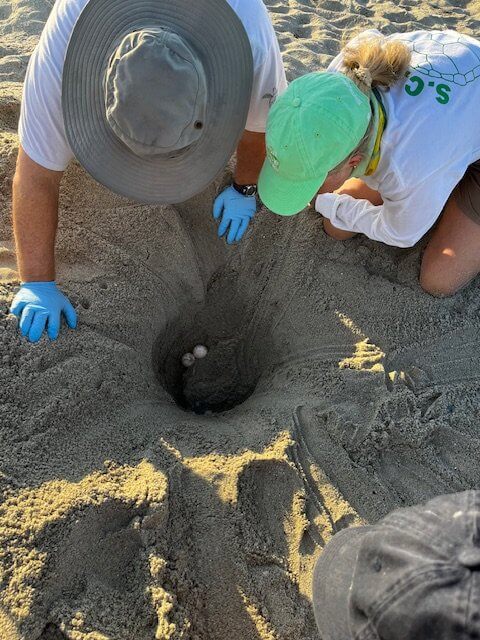
Schneider is supported by her co-coordinator Dianna Eastman and the local resident volunteers. Under a permit from the SCDNR, SCUTE volunteers serve as stewards to protect the turtles’ nesting habitat and as educators to those who show an interest in learning more about our turtles and how to help them.
Ask a volunteer
Schneider said SCUTE volunteers wear distinctive T-shirts, and the public is invited to ask them any questions about sea turtle nesting.
“When you see a person on the beach with a SCUTE T-shirt, they are doing their jobs to protect turtle nests,” she said. “Ask them anything and they will tell you what they are doing and why they are doing it.”
When Schneider started with SCUTE, she said it was a good year to have 10 nests on Pawleys Island. She said in recent years, those numbers have increased substantially.
“These people are dedicated and have been doing this for a long time,” Schneider said. “Some of the people who walk Pawleys Island beach have been walking for 15 years or more.”
“So,” she continued, “what we are doing is certainly helping the population.”
History of SCUTE
SCUTE was formed in 1990 by Chris Marlow and Jeff McClary, who is now deceased, in response to the need for better protection of sea turtles’ nests on Pawleys Island. Since its beginning at Pawleys, SCUTE has initiated volunteer programs at 13 different beaches in Georgetown and Horry counties.
Schneider expressed an appreciation for the continuing legacy of the founders of SCUTE and for 35 years of sea turtle protection.
“The steady increase of yearly nest numbers on Pawleys Island reflects the known frequency of hatchlings maturing in 25-, 30-plus years, having imprinted the earth’s magnetic field where they were laid, and returning to lay their own generations of nests,” she said.

About sea turtles
There are seven species of sea turtles worldwide: loggerhead, leatherback, green, Kemp’s Ridley, flatback, hawksbill, and olive Ridley. Virtually all turtles that lay nests on Pawleys Island are loggerheads – a species over 150 million years old. Adult loggerheads are usually three feet by four feet in size and weigh about 300 pounds.
In recent years, loggerheads have made a recovery despite still being classified as endangered by the U.S. Department of the Interior. Nesting on Pawleys Island has increased from an average of eight nests a year from 1996 to 2001 to an average of 20-plus nests in the years 2010 – 2022. There was a record number of 35 nests on Pawleys Island in 2021 with 30 more in 2022. Loggerhead nests incubate for an average of 60 days with hatching almost always occurring in the coolest/darkest hours of the night.
Nest inventories
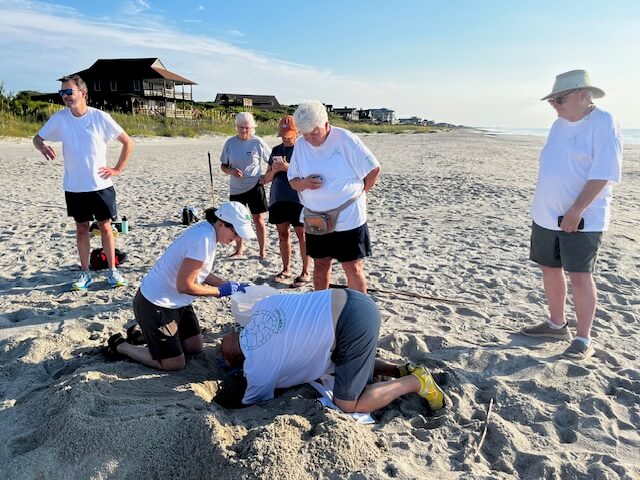
Three days after a hatching is reported by a SCUTE volunteer, the nest is inventoried and its varied contents (hatched shells, live hatchlings, un-hatched shells, dead hatchlings) are reported to the SCDNR. Hatchlings that are alive in the nest are then guided as they crawl to the ocean.
(Photo by ©maryschneider@sc.rr.com)
These inventories, which are posted at Pawleys Island Town Hall and the SCUTE Facebook page, are excellent opportunities for the public, particularly children, to learn about sea turtles and their protection.
Scott said that with 50 nests, SCUTE has invited the public to about 16 inventories. They try to be respectful of parking challenges, the distance of the walk to the nest required, the weather, etc. and only have public inventories that are accessible.
“We post those that are public two to three days ahead of time and will quite often have 250 people show up,” he said. “We like doing them because we focus on the kids and believe they are our future volunteers!”
Schneider said there have been a large number of very interested onlookers at our public inventories.
“We welcome people to come experience these inventories,” Schneider said. “We love to focus on children because they are the next generation who are learning to take care of the earth.”
By Clayton Stairs / tourism manager for the Georgetown County Chamber of Commerce